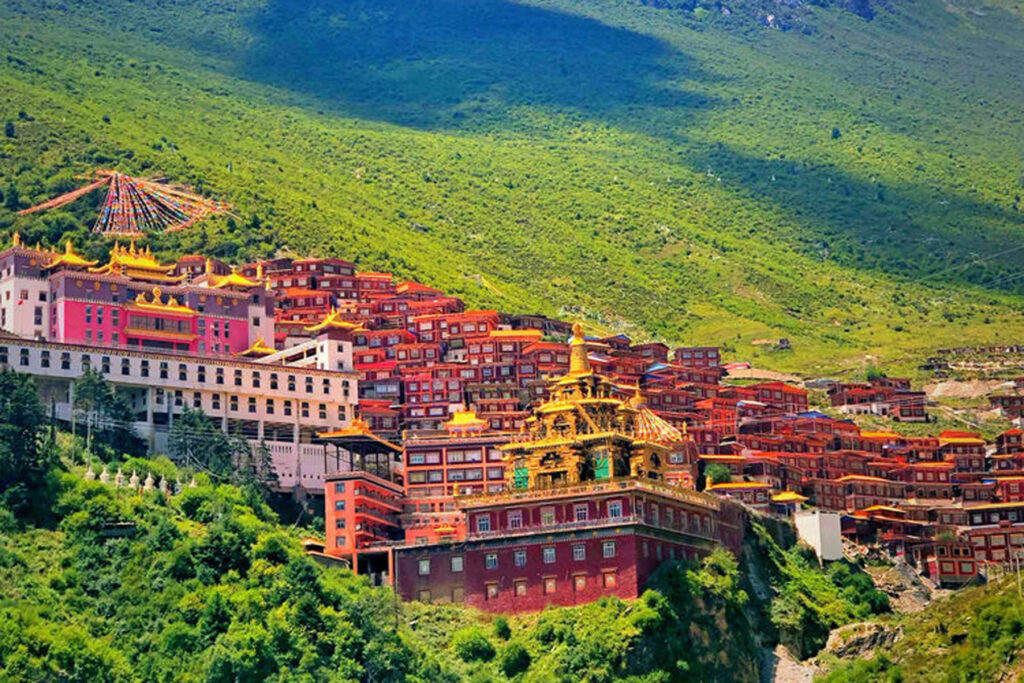
The Palyul lineage

Teachings

The Palyul lineage

The Luminous Flame of Doctrine and Practice (1665)

- 1 -

The Great Vidyadhara Kunzang Sherab: A Reincarnation Across Millennia

In 1665, nestled at the foot of the snow-capped mountains in eastern Tibet’s Derge region, a crimson monastery emerged from the morning mist. The echoing sound of bells intertwined with the rhythmic recitation of The Heart Essence of the Great Perfection, flooding the valley like a tide. This was Palyul Monastery, one of the six great mother monasteries of the Nyingma school, and at its heart stood a revered figure—the one honored as the emanation of a Bodhisattva, Kunzang Sherab.

Past Life Connections:

  • Rahula: The son of the Buddha, renowned for his mastery of secret practices, reincarnated as Kunzang Sherab to widely propagate esoteric teachings.
  • Śrī Siṃha: The Indian master of the Great Perfection, who transmitted the Heart Essence teachings to Padmasambhava, continuing his dharma lineage in this life.
  • Gyenyen Tamotara: A treasure revealer from the Tibetan imperial period, known for harmonizing Sutra and Tantra, reincarnated as Kunzang Sherab to establish a tradition integrating doctrine and practice.

Accomplishments in This Life:

When Kunzang Sherab took charge of Palyul Monastery, it housed only a few hundred monks. He established an iron rule: “Those who do not debate the scriptures shall not eat, and those who do not engage in practice shall not sleep.”

  • Morning Bells: At dawn, a thousand monks gathered in the main hall, engaging in rigorous debates on Madhyamaka and Prajñāpāramitā. Their voices shook the rafters.
  • Evening Drums: As the sun set, all retreated to their meditation chambers to practice Trekchö (cutting through) and Thögal (leap-over). Under the moonlight, some monks radiated a faint glow, resembling scattered fireflies.

Within a decade, the monastery expanded to three thousand monks. The main halls stretched like mountain ridges, and the library housed ten thousand scriptures, transcribed in golden ink, shining like the sun.

- 2 -

The Five Great Heart Disciples: A Dharma Lineage Like a Flourishing Tree

Kunzang Sherab once said, “A lineage cannot rest on one person alone. It must spread like a great tree, sheltering all beings.” His five foremost disciples each left an indelible mark:

  1. Pema Lhundrub Gyatso: The Heart of the Palyul Lineage
    -Chief Heart Disciple: Kunzang Sherab personally transmitted the Four Cycles of Heart Essence to him, appointing him to oversee Palyul Monastery.
    A Model of Practice: He meditated in retreat for three years. When he emerged, the snow at his cave’s entrance had melted into lotus shapes. His treatise, Stages of Great Perfection Practice, remains a core text of the Palyul tradition.

  1. Shepa Yeshe: The Debate King of Lhatzé Monastery
    – A Legend of Monastic Expansion: He led a hundred monks to establish Lhatzé Monastery in western Tibet, overcoming resistance from local Bön shamans through three days of logical debate, after which they converted and donated land for the monastery.
    -A Reformer of Buddhist Logic: He pioneered the Three Questions, Nine Answers debate method. His disciples memorized Pramāṇavārttika ten times daily, earning Lhatzé the reputation of producing scholars with “iron teeth and copper tongues.”


  1. Janggang Abé: The Medical Sage of Janggang Monastery
    -Spreading the Dharma Through Medicine: He founded Janggang Monastery in the Valley of the Medicine King, where monks studied the Four Medical Tantras by day and practiced Medicine Buddha sadhanas by night.
    -A Miraculous Medicine Field: Surrounding the monastery was a vast medicinal garden irrigated with glacial water. The saffron produced there, known as Janggang Tibetan Saffron, was said to cure hysteria and was revered as the Flower of the Buddha’s Hand.

  1. Hungchen Beiding: The Vajra Warrior of Hungchen Monastery
    -A Guardian Against Malevolent Forces: He built Hungchen Monastery in a land plagued by spirits. The monastery’s secret chamber housed a statue of Nine-Faced Vajrakīla, and all monks practiced the ritual of the Phurba dagger.
    -A Divine Intervention: When an epidemic swept the region, he led a seven-day Vajrakīla Fire Offering. On the final day, black hail fell from the sky, and the epidemic dissipated with the cries of fleeing spirits.

  1. Tsangga Dorje Tashi: The Master of Sacred Arts in Tsangga Monastery
    -Bringing the Dharma to Life Through Art: He founded Tsangga Monastery along the banks of the Jinsha River, dedicating it to the preservation of thangka painting, mandala creation, and sacred music.
    -A Treasure of the Monastery: He personally painted the Eight Manifestations of Guru Rinpoche, using pigments ground from turquoise and gold leaf. The artwork has retained its brilliance for centuries, and legend holds that Guru Rinpoche’s eyes in the painting appear to move.

- 3 -

A Hundred Monasteries Flourishing: The Dharma Network Across Tibet

After establishing these monasteries, Kunzang Sherab set forth Three Fundamental Precepts:

  1. Doctrine as the Root: Every monastery must establish a debate college, where monks must study the Five Great Treatises.
  2. Practice as the Trunk: Every winter, a three-month retreat dedicated to Great Perfection meditation must be observed.
  3. Altruism as the Leaves: Monks must study medicine and astrology, serving the people through healing and prayers.


The Expansion of the Palyul Lineage:

  • The Five Mother Monasteries: Lhatzé, Janggang, Hungchen, Tsangga, and Zhakok Weiseling Monasteries, each excelling in a unique aspect of Dharma.
  • The Hundred Branch Monasteries: Scattered like stars across Tibet, including Kham’s Katok Monastery and Amdo’s Langtso Monastery.


A Thousand Dharma Centers: By the 18th century, the Palyul lineage encompassed over a thousand monasteries, with its reach extending across the Himalayas, including Bhutan’s Taktsang Monastery

- 4 -

The Moonlit Transmission: A Night in 1665

On the eve of his passing, Kunzang Sherab summoned his disciples to the topmost shrine hall of Palyul Monastery. Bathed in silver moonlight, he rested his hand on the manuscript of The Heart Essence of the Great Perfection and softly spoke:

“Doctrine is like a lamp that dispels the darkness of ignorance; practice is its oil—without oil, the lamp cannot burn. Engage in debate to cut through delusion, and enter retreat to realize the nature of mind. If ever the golden rooftops of our monasteries are covered in dust…”

Before he could finish, an eagle’s cry pierced the night sky. The disciples looked up to see a radiant rainbow light dissolving into the eastern horizon.

The next morning, only a verse remained on his table:

“Palyul is neither white nor jade,
Doctrine and practice unfold its wings.
If one asks where this lineage flows,
The luminous mind shines for ages untold.”

The Palyul Lineage Today

Today, Baiyu Monastery remains a stronghold of practice within the Nyingma tradition. Every year, during the sixth month of the Tibetan calendar, the monks revive the “Three Practices of Kunsang Sherab”:

  • Ten Thousand Monks Debating: A thousand tents rise across the grasslands, and the echoes of debate thunder through the valley.
  • A Thousand Lamps of Retreat: Disciples enter mountain caves to practice “Thögal,” while offerings of butter lamps stretch like a river of stars outside.
  • A Hundred Healers on Pilgrimage: Monastic physicians travel across a hundred miles, carrying medicine pouches engraved with the six-syllable mantra of Janggang Monastery.

The elders often say:
“Look at the beams and pillars of the assembly hall—each one was placed by Kunsang Sherab himself and, to this day, not a single one has been touched by decay. For every piece of wood has been soaked in the sweat and aspirations of devoted practitioners.”

A Single Sentence to Remember Baiyu’s Legacy

One reincarnated disciple, five great heart-sons, a hundred monasteries rooted in teachings and practice—together, they ignite an everlasting beacon of awakened mind in the eastern snowlands.

🪷🪷🪷